
REVERSE OSMOSIS
Reverse osmosis is a technology that uses a special membrane to remove fine particles, bacteria, viruses and microplastics from water, as well as much smaller particles such as pesticide molecules, heavy metal salts and even calcium, magnesium and sodium salts. The result is very pure water, free of almost all impurities and minerals.
At the heart of reverse osmosis is a membrane with extremely small pores, in the order of 0.0001 microns (one ten-millionth of a millimetre). Only very small molecules, such as water, can pass through it. Larger molecules and ions, such as heavy metal ions or pesticides, do not fit into the pores. Under normal conditions, a phenomenon called osmosis would occur on such a membrane – water molecules would flow from the clean water into the polluted water, not the other way round. That is why the technology is called reverse osmosis: the process is reversed by applying pressure.
By creating higher pressure on the polluted side (with a pump or mains pressure), water molecules pass from the polluted side to the clean side, not vice versa. The water on the “dirty side” becomes more concentrated – the more concentrated the salts and impurities, the harder it is to purify the water, and the required pressure would rise beyond what the unit could deliver. That is why reverse osmosis discharges part of the water with the impurities (the concentrate) to the drain. A pumped reverse osmosis system therefore needs electricity, and every system needs a drain connection for the concentrate.
It should be noted that water from any reverse osmosis system is very pure, but it also lacks beneficial minerals such as calcium and magnesium. If you use reverse osmosis as your source of drinking and cooking water, we recommend alternating it with mineral water to replenish these important components.
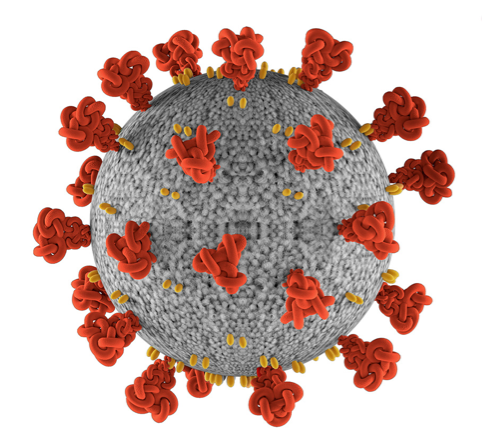
Virus (e.g. SARS-CoV-2)
typically around 0.1 microns (sheep)
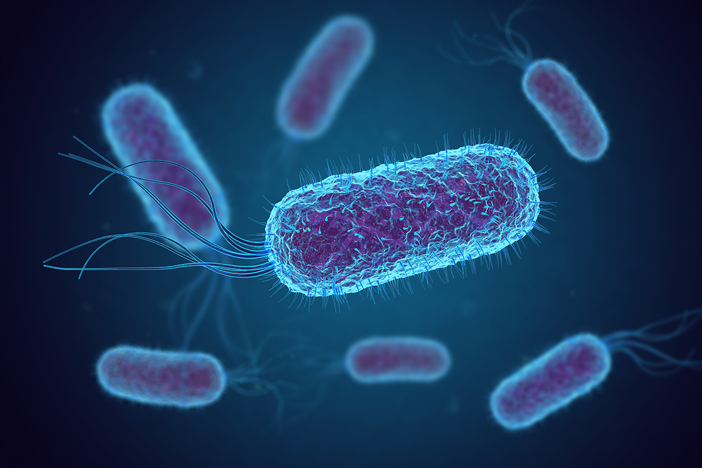
Bacteria (e.g. E. coli) – 0.3–10 microns (whale)

Reverse osmosis membrane pore size is 0.0001 microns (ant)
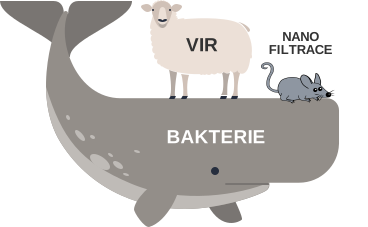
Nanofiltration membrane pore size is 0.001 microns (mouse)
NANOFILTRATION
Nanofiltration is one of the most advanced filtration technologies. It uses a special membrane with a pore size of typically 0.001 microns (one millionth of a millimetre). Such small pores remove not only turbidity, rust, bacteria (0.3–10 microns), viruses (0.02–0.3 microns) and microplastics, but also large organic molecules and multivalent metal ions. The membrane is partially permeable to minerals. If your water contains heavy metals, is too hard, or you want to remove not only bacteria, viruses and particles but also organic pollution, nanofiltration is the ideal solution.
Nanofiltration also needs pressure to speed up an otherwise very slow filtration process – higher than ultrafiltration, but usually lower than reverse osmosis. A unit similar to a reverse osmosis system can therefore often be used; the main difference is the membrane. As mentioned above, nanofiltration removes organic substances from water, typically pesticides, endocrine disruptors and chlorination by-products (e.g. chloroform), because these molecules are larger than the “opening” in the membrane. The same applies to heavy metals, whose cations are hydrated in water – a tightly bound layer of water molecules surrounds the ion and considerably increases its diameter. To prevent the membrane from clogging, the impurities must be flushed away. That is why nanofiltration needs a drain connection and electricity.
Water from nanofiltration is better suited to the body than water from reverse osmosis, because it partly retains minerals. It is a technology we clearly recommend for removing organic residues and other substances from water.
ULTRAFILTRATION
Ultrafiltration uses a membrane with a pore size of typically 0.01 microns (one hundred-thousandth of a millimetre). Such small pores remove turbidity and rust, as well as bacteria (typically 0.3–10 microns) and viruses (0.02–0.3 microns). Minerals pass through the membrane, as do dissolved organic pollutants such as pesticides, and heavy metals. If your water contains no heavy metals, is not too hard, and you mainly want to remove bacteria, viruses and particles, ultrafiltration is the ideal solution – for example for well water.
Ultrafiltration also works thanks to pressure, which speeds up the naturally slow filtration process; normal mains pressure is usually sufficient. To prevent the membrane from clogging, the impurities must be flushed away. That is why ultrafiltration needs a drain connection. Most of our ultrafiltration units do not need electricity – the exceptions are the IMT-D5 and IMT-U8 PSG.
Water from ultrafiltration is better suited to the body than water from reverse osmosis, because it retains dissolved minerals.
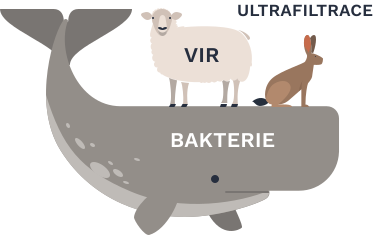
Ultrafiltration membrane pore size is 0.01 microns (hare)
WATER SOFTENING
The best way to soften water is an ion exchanger. It removes most of the calcium and magnesium ions from the water, and the degree of softening can be adjusted. H2O nanotec offers whole-house water softeners that work automatically and solve hard water problems for good. Reverse osmosis can be used as an alternative, but its drawback is that it produces only small amounts of water.
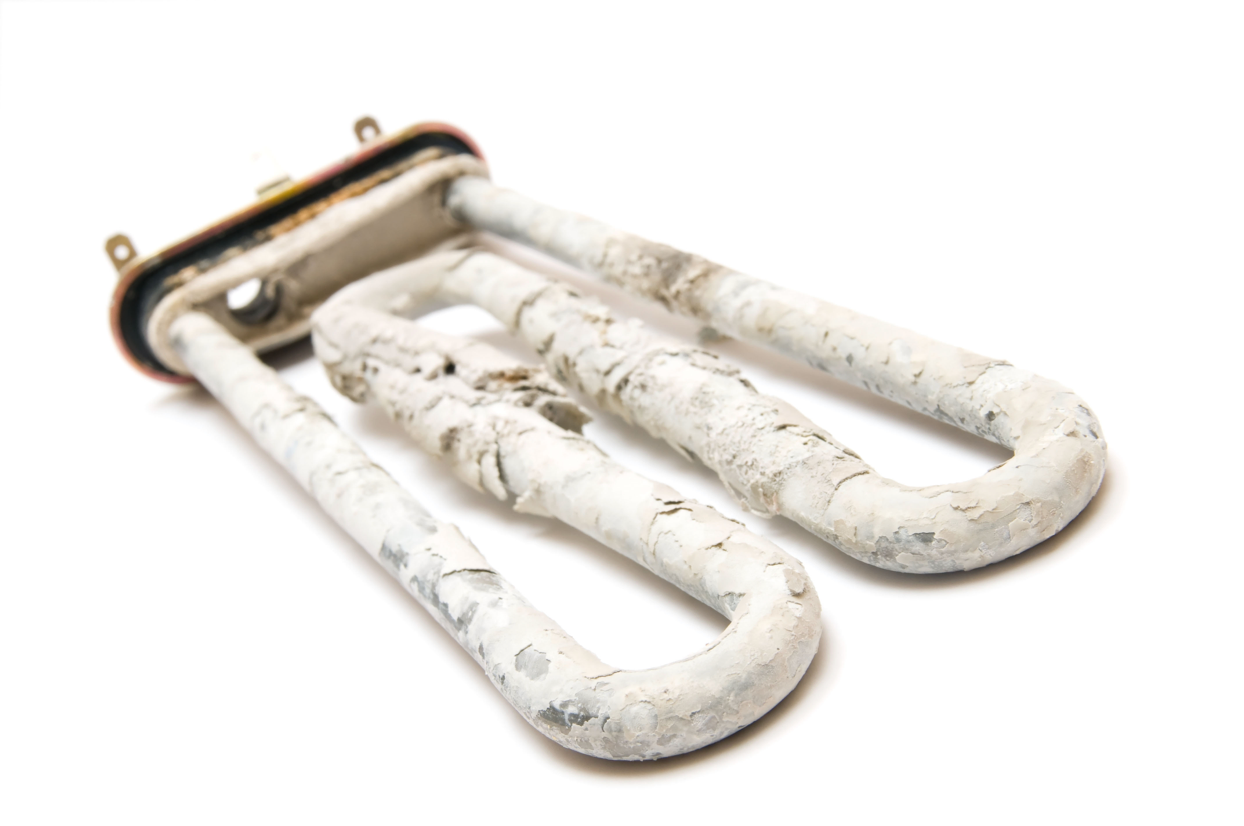
Natural water contains dissolved minerals. If it contains a lot of them, especially calcium and magnesium, we call it hard water. Calcium and magnesium enter water underground, where limestone in the presence of carbon dioxide forms calcium bicarbonate, which dissolves in water. Such water usually tastes good, but it is hard on household appliances. Whenever it is heated, the dissolved calcium bicarbonate breaks down again into carbon dioxide and insoluble calcium carbonate (limestone). This settles on sanitary ware and inside appliances and destroys their heating coils. It forms a thin film on tea and makes coffee less tasty.
The most effective way to soften water is an ion exchange resin (a similar one is used in your dishwasher, which you top up with regeneration salt). As water flows through, the resin “exchanges” calcium, magnesium or ferrous ions for sodium ions, and the hard water problem is solved. Over time the resin becomes saturated with calcium and magnesium ions and needs to be regenerated. This is done with a brine solution, which displaces the bound calcium and magnesium ions from the resin and flushes them to the drain. The resin is then ready to soften water again.

