
How does ozone in water act on microorganisms? In short – it reliably destroys them. You will find the evidence below. In this article I also present the results of antiviral, antibacterial and fungicidal tests of the BioSure Professional Ozone Surface Cleaner carried out in Barcelona.
Ozone (O3) is one of the best and most effective disinfectants we know. Its advantage is that it can be produced relatively easily from air or water. No chemicals are needed, and ozone itself breaks down very quickly into ordinary oxygen.
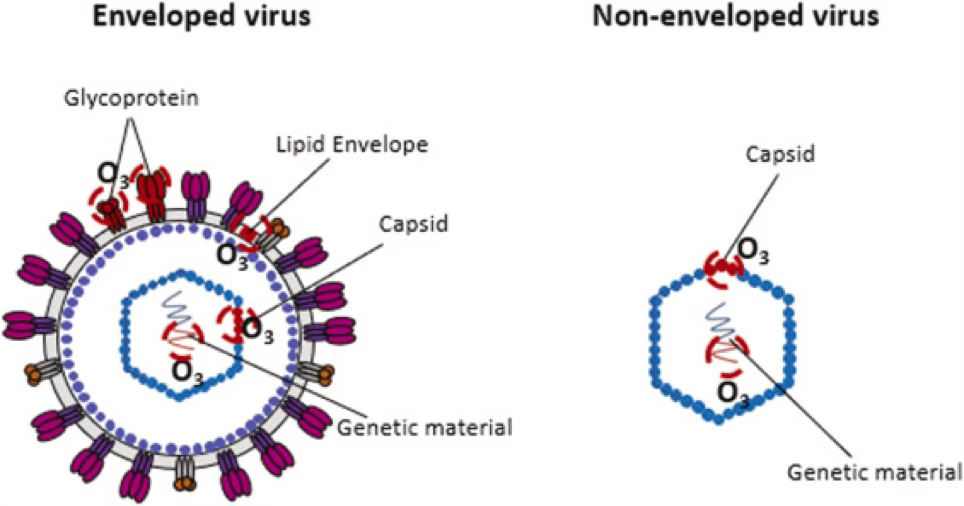
Ozone disrupts the cell membranes and cell walls of single-celled microorganisms. It oxidises and breaks down phospholipids and lipoproteins, and the damage to the cell wall causes bacterial lysis and death. It also deactivates some enzymes inside the cells by oxidising their thiol groups. The enzyme changes its structure and stops working.
Ozone acts on viruses in a similar way. It disrupts their lipid (fatty) envelope and oxidises the viral surface proteins (e.g. the spike protein anchored in the viral envelope) that the virus uses to bind to the host cell and enter it. Concentrations of around 1 ppm of ozone in water are usually sufficient for disinfection. The reaction is fast – from seconds to a few minutes.
Because ozone concentration is an important parameter, we tested the ozone water from the BioSure Professional Ozone Surface Cleaner bottle in our laboratory using permanganometry. We measured 5.52 ppm of ozone, a concentration sufficient for excellent antibacterial, antiviral and antifungal properties.
Ozone concentration measurement report (in Czech)
Tested at InOqua Instituto
BES, the manufacturer of the BioSure Professional Ozone Surface Cleaner, had a series of tests of its product carried out at InOqua Instituto near Barcelona. The tests included the fungi Aspergillus brasiliensis and Candida albicans.
Their cultures were reduced 10,000-fold. Cultures of the bacteria Pseudomonas aeruginosa, Escherichia coli, Staphylococcus aureus, Enterococcus hirae, Listeria monocytogenes and Salmonella enterica showed an even higher effectiveness: a 100,000-fold reduction. For viruses, poliovirus was reduced 10,000,000-fold and adenovirus 1,000,000-fold.
Ozone was compared with formaldehyde, which is known as an extremely strong antiviral agent, and the tests found that the ozone water generated by the BioSure Professional Ozone Surface Cleaner kills a thousand times more bacteria than formaldehyde at its usual concentration.
InOqua – official test results for
When ozone disinfection helps
Higher organisms (such as humans) are much better protected against ozone than microorganisms. The skin has a protective layer – the epidermis, made of dead keratinised cells with fatty substances between them. This forms an effective barrier against the action of ozone on human skin. Before ozone could reach the first living cell, it is "used up" in the epidermis, which constantly renews itself.
Ozone can also break down organic substances such as pesticides. Here, however, ozone needs to act much longer, from minutes up to half an hour, because the reactivity of these compounds is much lower than that of the lipoproteins or proteins of microorganisms.
The greatest advantages of ozone disinfection are its effectiveness and speed. At the same time, ozone breaks down into harmless oxygen, so we do not burden the environment and still have very effective protection at our disposal.
This time we focused exclusively on how ozone acts on microorganisms. Next time we will look at practical applications of ozone water.
What can BioSure Professional do?
Written by:
RNDr. Jiří Polman CSc., Managing Director

